Field Risk Atlas
A parcel-level map of California’s farmland water risk.
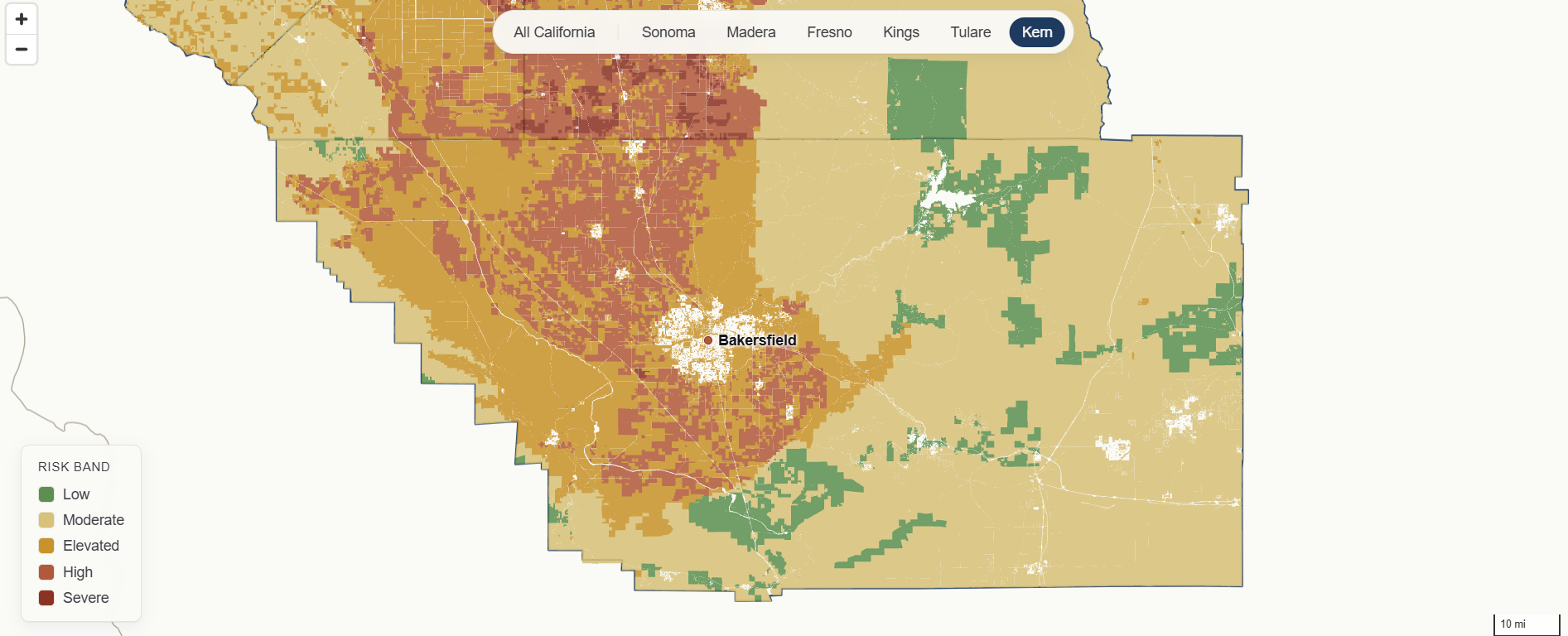
Scores every farmable parcel in nine San Joaquin Valley and Sonoma counties on water risk. Built from public data — basin status under California's Sustainable Groundwater Management Act (SGMA), water-district reliability, dominant crop type, local well depth, and drought exposure. Output is a 0–100 score and a five-band classification anyone can audit. Search by APN to pull up a specific parcel, or pan the map.
374,738
parcels scored
17.9M
acres covered
9
California counties mapped
32%
of acres in Elevated band or higher
Where the risk concentrates
Nine counties, each with its own story
Each row shows total farmable acreage for one county, broken down by risk band. The Tule and Tulare Lake subbasins are both classified “Probationary” under SGMA — meaning the state has flagged their groundwater plans as inadequate — which shows up as a meaningful share of higher-band acreage in the corresponding counties. Sonoma sits on a different aquifer regime with more reliable surface water, which the data reflects.
What is grown
Top crop classes across the footprint
Sourced from California Department of Water Resources Land IQ and the U.S. Department of Agriculture (USDA) Cropland Data Layer.
Plus 10.5M acres (60% of footprint) classified as fallow or non-cropped — rangeland, dry-farmed acreage, and undeveloped agricultural parcels not in active production.
The footprint
~375,000 farmable parcels across ~17 million acres in nine counties: Sonoma, San Joaquin, Stanislaus, Merced, Madera, Fresno, Tulare, Kings, and Kern.
The signals
Seven public-data inputs from the California Department of Water Resources (DWR), the U.S. Department of Agriculture (USDA), the U.S. Drought Monitor (USDM), and the American Society of Farm Managers and Rural Appraisers (ASFMRA).
The crops
Almonds, pistachios, walnuts, vineyards, citrus, cotton, alfalfa, row crops, and rangeland — high-water-demand permanent crops, flexible annuals, and fallowed acreage.
Methodology in one paragraph
How the score is built
Each parcel is matched to the groundwater basin, Groundwater Sustainability Plan (GSP) area, water district, and dominant crop boundary it falls within. Seven weighted components combine into a 0–100 composite: basin priority designation (15%), GSP status under SGMA (25%), critical-overdraft basin flag (10%), water-tier ranking from the American Society of Farm Managers and Rural Appraisers (ASFMRA, 20%), crop type (15%), local well depth ranking (10%), and U.S. Drought Monitor severe-drought exposure over the past 52 weeks (5%). Risk bands sit at 0–35 (Low), 36–55 (Moderate), 56–70 (Elevated), 71–85 (High), and 86–100 (Severe).
Full methodology →